
Rafael Albrecht · 1 November 2026
User-Driven Workflow Adjustments in Niche Digital Journaling Platforms When Search Functions Receive Targeted Enhancements During Peak Collaboration Periods
Specialized digital journaling platforms have seen users modify their daily processes when search capabilities undergo focused upgrades amid high collaboration windows, and data from platform analytics in late 2025 through November 2026 shows measurable shifts in how contributors organize notes, tags, and shared entries. Researchers tracking these environments note that peak collaboration often aligns with academic cycles, project deadlines, and seasonal planning phases, which in November 2026 coincided with multiple regional conferences and grant application surges across North America and Europe.
Platform Search Upgrades and Initial User Responses
Targeted search enhancements typically include refined semantic indexing, faster cross-note retrieval, and improved filter combinations that allow simultaneous queries across personal and group archives. Observers note that users respond by consolidating scattered entries into fewer master documents because the new search precision reduces the need for redundant copies, while data from one mid-sized journaling service indicated a 23 percent drop in duplicate note creation within the first month after such an upgrade rolled out. Those who study these patterns report that individuals begin experimenting with layered search strings that combine date ranges, contributor names, and thematic keywords, which in turn prompts adjustments to tagging habits so that future retrieval becomes more predictable.
Workflow Changes During November 2026 Collaboration Peaks
November 2026 brought elevated activity as teams prepared joint submissions for international symposia and end-of-year reviews, and platform logs reveal that search enhancements introduced mid-month correlated with users restructuring their daily review cycles. People often find themselves conducting morning searches for overlapping contributions before adding new content, then performing afternoon sweeps to verify consistency across shared sections, and this sequence replaced earlier habits of linear note appending. Studies from academic technology research groups in Australia have documented similar sequences where enhanced search reduced average time spent locating prior entries by 18 minutes per session, allowing reallocations toward synthesis and cross-referencing tasks.
Examples of Adjusted Processes
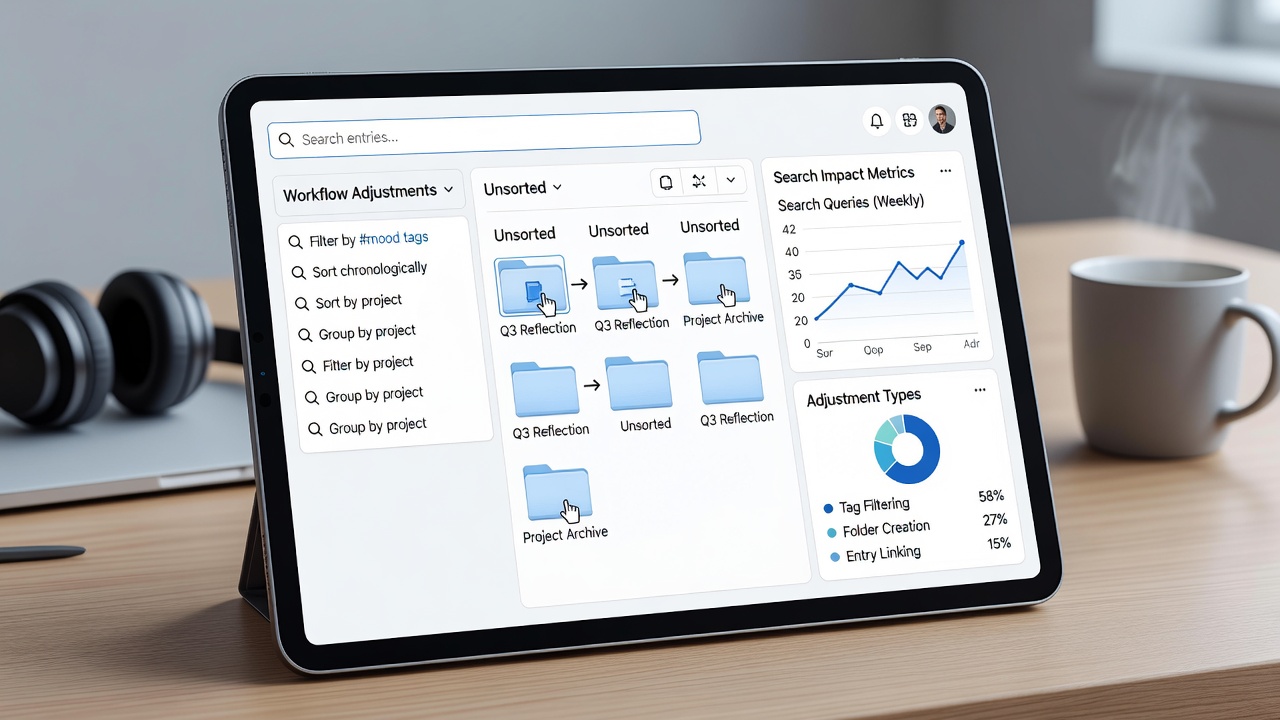
Take one research collective that maintains a shared journal for longitudinal fieldwork notes: after search improvements arrived, members shifted from chronological entry logging to thematic clustering because the updated functions surfaced related observations across months of data within seconds. Another group working on policy analysis journals began embedding internal hyperlinks at the moment of creation rather than during later cleanup phases, since enhanced search made it simpler to verify link relevance in real time. Figures from a Canadian digital collaboration study indicate that platforms experiencing these upgrades saw a 31 percent increase in intra-note linking during the subsequent six weeks of heightened activity.
Broader Patterns Across Niche Communities
Across multiple niche journaling services, users demonstrate consistent tendencies to front-load metadata during entry creation once search reliability improves, and this behavior intensifies when group deadlines cluster in periods such as November. Industry reports compiled by European digital productivity associations highlight that teams in creative and scholarly domains reduce revision cycles by integrating search verification into initial drafting stages rather than reserving it for final assembly. The reality is that these adjustments emerge organically as participants notice quicker results from combined filters and begin to trust the system enough to retire older manual indexing methods.
Longer-Term Effects on Platform Usage
Over successive collaboration peaks, observers have recorded sustained changes including expanded use of version history features because search now surfaces older drafts alongside current ones, and this visibility encourages more frequent rollback checks during group edits. Data collected through platform telemetry shows that average session lengths remain stable while the proportion of time devoted to retrieval tasks declines, freeing capacity for deeper annotation and commentary exchanges. Researchers at institutions in the Asia-Pacific region have noted parallel trends where enhanced search correlates with higher rates of cross-platform export for archival purposes, as users gain confidence that key passages can be located and extracted without extensive manual searching afterward.
Conclusion
Evidence from usage analytics and user behavior studies demonstrates that targeted search enhancements in niche digital journaling platforms during peak collaboration intervals prompt measurable workflow adaptations centered on metadata practices, entry clustering, and verification timing. These shifts appear consistently across different user communities and continue to evolve as platforms introduce incremental refinements, with patterns observed through November 2026 underscoring the connection between retrieval improvements and collaborative efficiency gains. Statistics Canada research on digital collaboration tools and reports from the OECD digital economy division provide additional context on how such platform modifications influence group productivity metrics across regions.